
Aligning Stakeholders and Roadmaps
How Dan Olsen’s Importance of User Need vs. Satisfaction Matrix Prioritizes What Matters Most

Product development is a complex process that requires balancing various factors, including market demands, technological feasibility, and business goals. One of the most challenging aspects of product management is prioritizing features and enhancements for the product roadmap. Disputes often arise when stakeholders-Sales, Marketing, Operations, Finance, Legal, Senior Leadership etc- have differing opinions on what should take precedence. Dan Olsen's "Importance of User Need vs. Satisfaction with Current Solutions" matrix is a powerful tool to navigate these conflicts, ensuring that product decisions are aligned with user needs and market realities.
In this article, we will explore the matrix in detail and provide a comprehensive guide on how to implement it effectively in your organization.
The Importance of User Need vs. Satisfaction with Current Solutions Matrix
Dan Olsen, a renowned product management expert and author of The Lean Product Playbook, introduced the Importance of User Need vs. Satisfaction with Current Solutions matrix as a method to evaluate and prioritize product features. The matrix serves as a strategic framework that helps product teams make informed decisions by analyzing two critical dimensions:
Importance of User Need: This dimension assesses how crucial a particular need or problem is for the target users. It answers the question, "How much does solving this problem matter to our users?"
Satisfaction with Current Solutions: This dimension evaluates how well current solutions, including your product and competitors' offerings, are meeting the identified user need. It answers the question, "How satisfied are users with the existing solutions?"
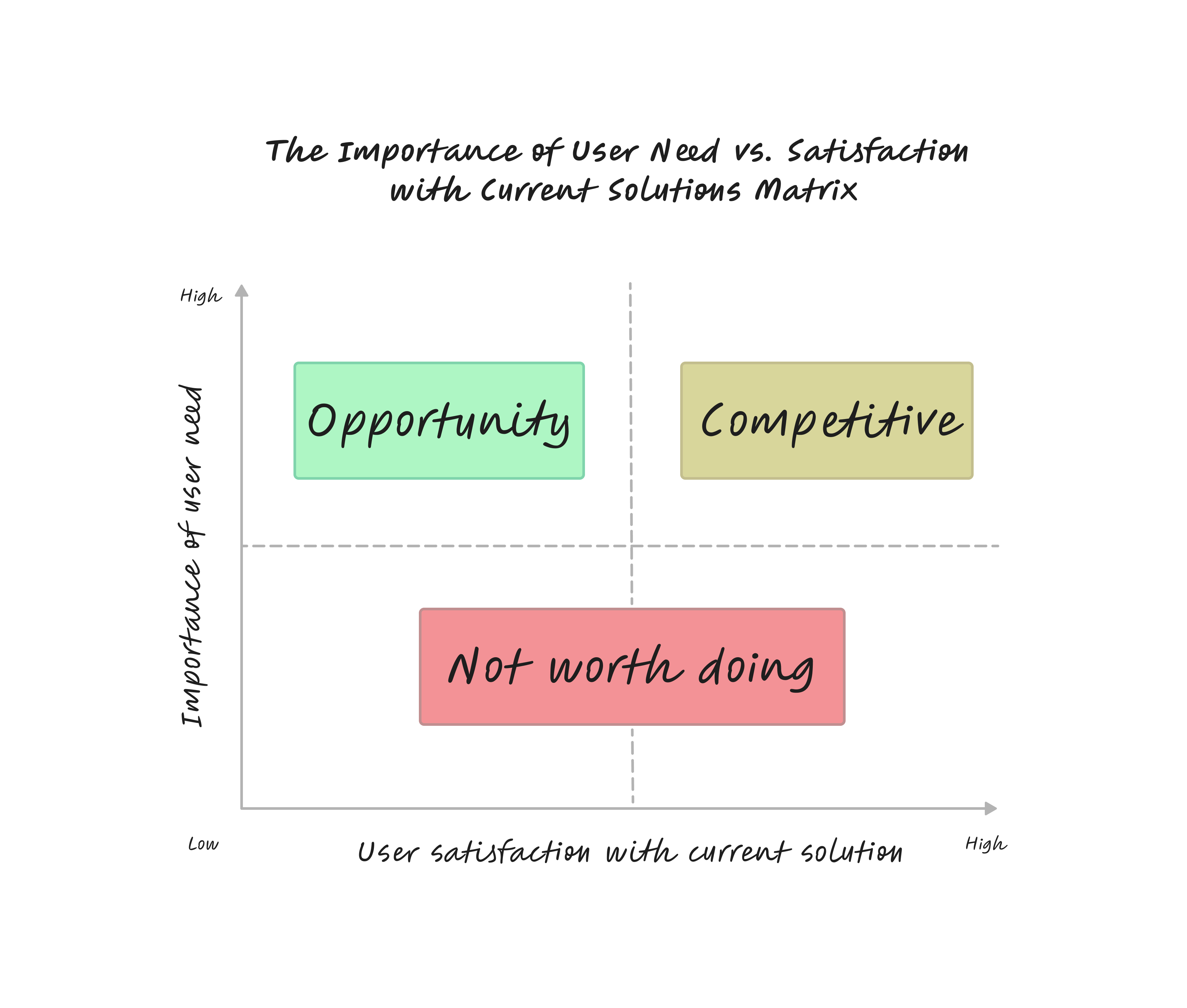
By plotting these two dimensions against each other, the matrix categorizes potential product features or enhancements into four quadrants, each guiding different strategic actions.
The Four Quadrants of the Matrix
To understand how the matrix guides decision-making, let's explore its four quadrants:
High Importance, Low Satisfaction: This quadrant represents opportunities for significant impact. Users have a critical need that is not being adequately addressed by current solutions. Features or improvements falling into this category should be high-priority items on the product roadmap because they can significantly increase user satisfaction and potentially capture market share from competitors.
High Importance, High Satisfaction: In this quadrant, the need is crucial, but current solutions are already meeting it effectively. While these features might seem important, further investment may only offer marginal gains. Prioritizing these could lead to diminishing returns unless there are opportunities to significantly outpace competitors or set new industry standards.
Low Importance, Low Satisfaction: Features in this quadrant are often distractions. The need is not pressing, and current solutions do not perform well. These are typically low-priority items since they are unlikely to drive significant user satisfaction or market success.
Low Importance, High Satisfaction: This quadrant indicates areas where users are already content with existing solutions, and the need is not particularly important. Investing in these features could result in wasted resources with minimal impact on user experience or business outcomes.
Why the Matrix Matters in Product Roadmap Disputes
Stakeholders often have strong opinions about what should be included in the product roadmap, influenced by their individual roles, experiences, and priorities. These opinions can lead to conflicts, particularly when different stakeholders advocate for different features or improvements. The Importance of User Need vs. Satisfaction with Current Solutions matrix provides an objective framework to navigate these disputes by grounding discussions in user-centric data.
1. Objective Decision-Making
The matrix shifts the focus from subjective opinions to objective analysis. Instead of relying on intuition or internal politics, the matrix encourages product teams to prioritize features based on how well they address critical user needs and how much they improve upon existing solutions. This data-driven approach can diffuse tensions among stakeholders, as decisions are made based on concrete criteria rather than personal preferences.
2. Alignment with User Needs
Product success hinges on satisfying user needs more effectively than competitors. By emphasizing the importance of user needs and satisfaction, the matrix ensures that the product roadmap is aligned with what users value most. This alignment increases the likelihood of developing features that resonate with the target audience, leading to higher user satisfaction, retention, and growth.
3. Efficient Resource Allocation
Resources in product development are often limited, making it crucial to invest them where they can have the most significant impact. The matrix helps prioritize features that are likely to deliver the highest return on investment by focusing on unmet needs with high importance. This approach not only maximizes the value delivered to users but also ensures that the product team’s efforts are focused on areas with the greatest potential for differentiation and competitive advantage.
4. Facilitating Stakeholder Buy-In
When stakeholders understand the rationale behind product decisions, they are more likely to support the roadmap, even if it does not align with their initial preferences. The matrix provides a transparent and logical framework that can be communicated to all stakeholders, fostering a shared understanding of the product strategy. This shared understanding can lead to greater alignment across the organization and reduce friction in the decision-making process.
5. Adaptability to Market Changes
The Importance of User Need vs. Satisfaction with Current Solutions matrix is not a static tool. As market conditions, user needs, and competitive landscapes evolve, the matrix can be revisited and updated. This adaptability ensures that the product roadmap remains relevant and responsive to changes, allowing the product team to pivot when necessary and maintain a competitive edge.
Implementing the Matrix: A Collaborative Stakeholder Exercise
To effectively implement Dan Olsen’s matrix in your product strategy, we recommend organizing a collaborative session with your stakeholders. This can be done in person using a whiteboard and post-its or virtually using tools like FigJam or Miro. Below is a step-by-step guide to conducting this exercise.
1. Organize the Collaborative Session
Decide on the format of the session—whether it will be in-person or virtual—based on the location and availability of your stakeholders. For in-person sessions, gather materials like a whiteboard, markers, and sticky notes. For virtual sessions, set up a workspace in tools like FigJam or Miro, which offer digital whiteboards and post-it functionalities.
2. Shift Focus to Problem Space
Begin the session by asking each stakeholder to individually write down the pain points or issues they believe need to be solved. This can be done on physical post-its for in-person sessions or on virtual post-its in the online tools. The focus here is on identifying problems, not proposing solutions. This approach helps move the conversation from solution space to problem space, where stakeholders think critically about the issues users face rather than jumping straight to feature requests.

3. Populate the Matrix
After identifying the problems, have each stakeholder place their post-its on the appropriate quadrant of the User Need vs. Satisfaction with Current Solutions matrix. This visual representation will help the team see where the most critical opportunities lie.
High Importance, Low Satisfaction: Urgent issues with high potential impact.
High Importance, High Satisfaction: Issues already well addressed.
Low Importance, Low Satisfaction: Low-priority issues, often distractions.
Low Importance, High Satisfaction: Areas where users are content, and further investment is not critical.

4. Justify the Positioning
Once all the problems are placed, go around the room (or virtual space) and ask each stakeholder to explain why they positioned their problem in a particular quadrant. This step is crucial as it helps contextualize the issues and may lead stakeholders to reconsider their initial assessments. This discussion often naturally relegates some issues to lower-priority quadrants when stakeholders see how their concerns compare with others’.
5. Finalize Quadrants 1 and 2
Facilitate a discussion to finalize the issues in Quadrants 1 and 2. Quadrant 1 issues should be prioritized as they represent high user need and low satisfaction, while Quadrant 2, although important, may offer diminishing returns due to the existing satisfaction levels. The group should reach a consensus on which problems are truly strategic and critical for the upcoming period.
6. Prioritize Quadrant 1 Based on Strategic Objectives
Next, focus on prioritizing the problems in Quadrant 1. This should be done in the context of the overall strategy for the next quarter or planning period. Consider the following buckets when prioritizing:
Business Objectives: What are the company’s goals for the next quarter?
Competitive Parity: Are there any features required to stay competitive?
Competitive Advantage: Which problems, if solved, would differentiate the product in the market?
Technical Debt: Are there underlying technical issues that need addressing?
User Needs: Which problems are causing the most friction for users?
Operational Bugs: What bugs or issues are critical to fix for smoother operations?
Big Bets: Are there any innovative, high-risk, high-reward opportunities?
Each bucket should have an assigned effort bandwidth. For example, if the next quarter’s focus is on gaining a competitive advantage, allocate 70% of the effort bandwidth to this area, with the remaining 30% split among big bets, bug fixes, and technical debt.
7. Validate with End Users
After stakeholders agree on the prioritized problems, it's essential to validate these with end users. Conduct user interviews, surveys, or usability tests to ensure that the problems identified as top priorities genuinely resonate with the user base. This step can further refine the priorities, especially if there are too many issues in Quadrant 1 that exceed the available effort bandwidth.
If stakeholders are still struggling to prioritize within Quadrant 1, involving users in the prioritization process can provide additional clarity and help break any deadlocks.
8. Move Into Solution Space with Design Thinking
Once the problems are validated and prioritized, the next step is to start exploring potential solutions. This is where the design thinking process comes into play, which will be covered in a follow-up article. The key is to maintain the user-centered focus established during the problem identification phase as you begin to brainstorm and prototype solutions.
Conclusion
Dan Olsen’s Importance of User Need vs. Satisfaction with Current Solutions matrix is an invaluable tool for product teams facing the challenge of roadmap prioritization. By shifting the focus from features to user needs, and facilitating a structured, collaborative discussion among stakeholders, the matrix helps ensure that the product roadmap is aligned with what truly matters to users. The result is a more strategic, data-driven approach to product development that minimizes internal conflicts and maximizes impact in the market.
Implementing this matrix through a collaborative session, whether in person or virtual, not only aids in prioritizing features but also fosters a shared understanding among stakeholders. This shared understanding is crucial for achieving alignment and ensuring the product development process remains focused on delivering value to users while meeting business objectives.